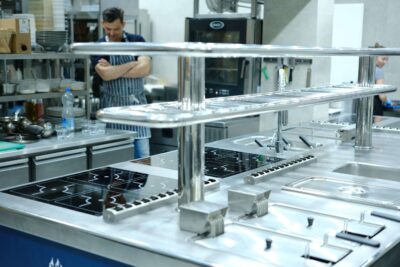
As a Polish manufacturer of professional catering equipment, Kromet has been supporting investors for years who are looking not only for equipment, but also for a partner for comprehensive implementation of back-of-house technology. Based on this experience, we have prepared 5 key principles that are worth knowing before you start designing your kitchen.
Start with your vision and operational data
It all starts with the question: what exactly do you want to serve and to whom?
When planning a kitchen, it is not enough to ‘have a place’. You need to know the scale of the business, the nature of the menu, the number of employees and the expected daily turnover of food. Investors often focus on the design of the dining room or marketing, leaving the design of the back-of-house for later – which can result in costly renovations or problems with the health and safety inspection.
At Kromet, we begin our cooperation with a detailed interview with the client. We ask about:
- the type of business (restaurant, bar, canteen, hotel),
- the number of meals served per day,
- the types of dishes on the menu,
- the kitchen team and the work schedule.
Only on this basis is a technological design created that not only meets sanitary requirements, but also realistically supports the team’s work. Importantly, it is worth involving the future chef in the design process. Their practical experience will help to take into account the daily habits and specific needs of the team.
Design compliant with health and safety standards
In catering, it is not enough for a kitchen to be ‘clean’. It must be designed to meet HACCP requirements, i.e. the Hazard Analysis and Critical Control Point system – a standard applicable to all food establishments in the EU.
HACCP is not just paperwork – it is the basis for the kitchen to operate in accordance with the law. Clean and dirty routes must pass through the kitchen separately, and water for hands cannot be used to wash meat, explains Anna Pyszczek, HACCP implementation expert and former employee of the Sanitary and Epidemiological Station.
A poorly designed kitchen not only exposes you to fines and corrections, but also slows down the team’s work and increases the risk of errors. That is why at Kromet, in our kitchen designs:
- we divide spaces in accordance with sanitary and hygiene requirements (pre-processing, thermal processing, washing-up, storage),
- take into account the number of water points, staff flow and so-called ‘clean paths’,
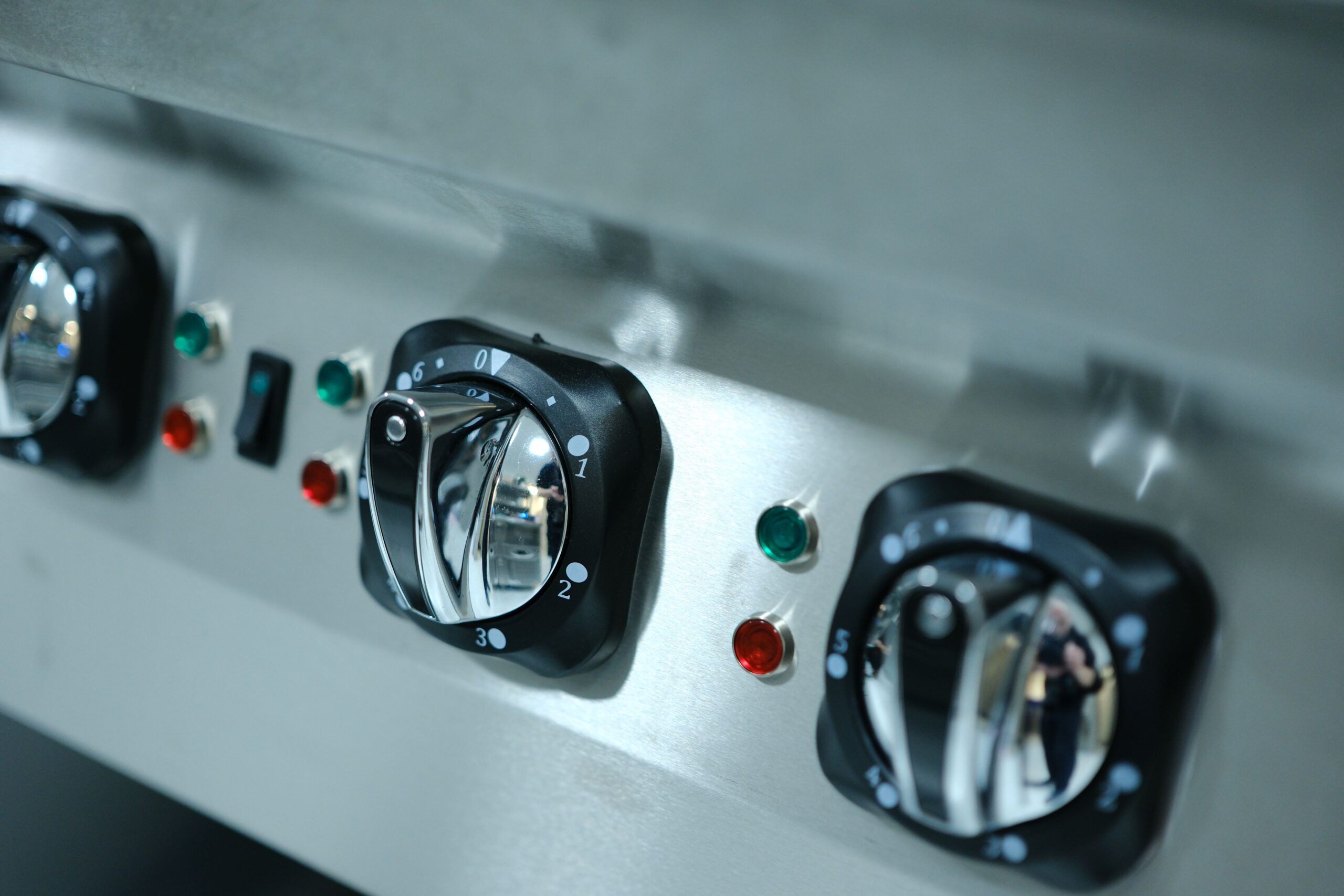
- use equipment that meets HACCP requirements – easy to clean, seamless, made of AISI 304 and 316 steel.
From an investor’s perspective, it is worth knowing that HACCP does not begin when the premises are handed over – it begins at the design stage. This is where Kromet comes in, offering a comprehensive kitchen design – solutions that avoid the mistakes typical of random architectural solutions.
Kitchen ergonomics and logistics – a kitchen is not a showroom
The aesthetics of the dining room can be detrimental if the kitchen design has been neglected. Unfortunately, many restaurants repeat this mistake, leading to a situation where there is nowhere to put the food on the plate because there are no worktops, as the HACCP specialist explains.
Not all designers are created equal. I have seen many kitchens designed by interior designers that looked like home kitchens. But gastronomy is not about a nice dining room, it’s about the kitchen working, notes Anna Pyszczek.
In the practice of designing catering facilities, the following are key:
- separate work areas that do not interfere with each other (e.g. the dirty dishwashing area should not intersect with the food service area),
- an adequate number of worktops – a lack of these generates chaos and inefficiency,
- a technological line – i.e. equipment arranged according to the logic of work: cooling → preparation → heat treatment → serving.
At Kromet, we have been implementing solutions that support ergonomics for years:
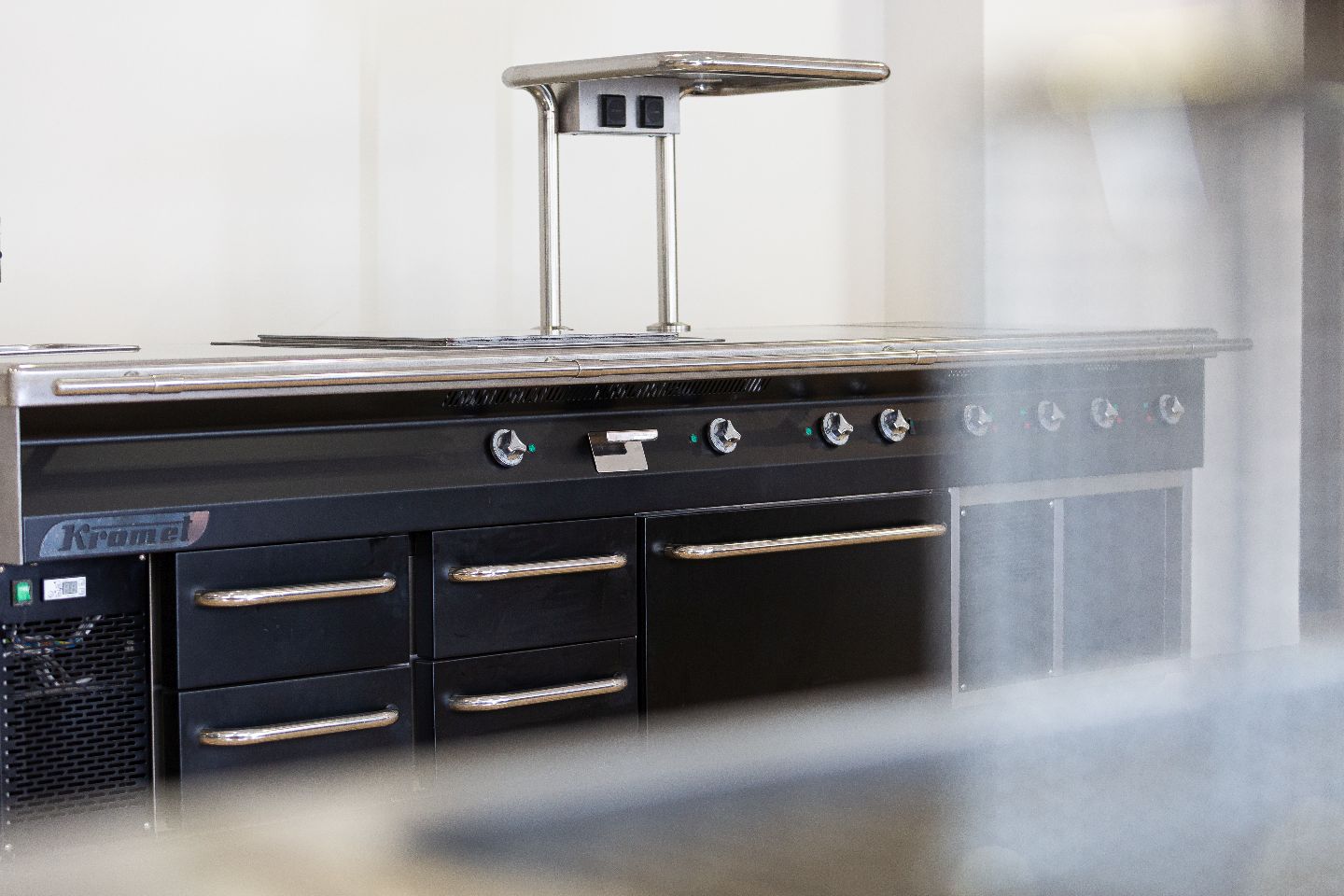
- modular lines 700 and 900 – they offer complete freedom of configuration and adaptation to the volume of the kitchen,
- monoblock designs – especially in open kitchens or those with limited space (as in the project for 4 Winds Resort & Spa),
- consistency of equipment – appliances with uniform dimensions and installation methods, which simplifies layout and servicing.
A good kitchen design should allow the chef to work ‘like clockwork’ – without having to backtrack, pass colleagues from the team and search for space for basic equipment.
A poorly designed space greatly reduces the comfort of work. You don’t walk around like in a factory – you just get annoyed that everything is out of place,” sums up Anna Pyszczek.
Focus on energy efficiency and reliability – with costs and comfort in mind
A modern kitchen is not only about functionality, but also about optimising energy consumption. In an era of rising electricity and gas costs, every investment in savings is a step towards the financial stability of the premises.
I work with restaurants that are only surviving because they have a sensibly designed kitchen and do not waste energy. And there are also those that, after two months, see that costs are eating them alive because they did not think through the purchase of equipment, emphasises the HACCP specialist.
What solutions does Kromet offer?
- Induction instead of gas – e.g. the 700 induction line allows you to save up to 50% energy, with an efficiency of up to 90%.
- Frying pans and boilers with automatic bowl lifting and water jacket – eliminate heat loss and the risk of burning.
- Digital controllers in selected devices – enable precise temperature and time settings, which is crucial for large-scale production and repeatable quality.
- By purchasing equipment that is serviced in Poland, you save not only energy but also time.
Trust one partner – design and equipment in one place
The last rule is the most overlooked but crucial aspect of any investment: avoid chaos and scattered responsibility. It is best if one proven partner is responsible for both the technological design and the selection and delivery of equipment.
Kromet offers a comprehensive service at projektkromet.pl, in which:
- we analyse the needs of the premises and create a design that complies with Sanepid and health and safety regulations,
- we select equipment from our own production – ready to use and with full service,
- we provide technical support at every stage – from design to installation and training.
The most difficult situations are those where one company does the design, you buy the equipment from another, and a third company does the acceptance. And everyone washes their hands of it. If something doesn’t work, everyone says, ‘It’s not us.’ At Kromet, you have one partner – and zero misunderstandings – notes Wiktor Tusiński, Commercial Director at Kromet.
What do you gain?
→ Technological consistency – the equipment is compatible with each other.
→ Confidence in compliance with standards – the design is developed with the participation of technologists and HACCP specialists.
→ Time savings – all stages of implementation in one place, without looking for intermediaries.
This solution is particularly suitable for investors who have no experience in catering or simply want a kitchen that works from day one – without stress and corrections.
Implement a project that works
If you are an investor who:
- plans to open a new kitchen (restaurant, hotel, bar, canteen),
- is modernising an existing premises and wants to optimise the technological layout,
- wants to be sure that everything will comply with standards and be ready on time…
…then we invite you to work with the Kromet team.
With us, you will design a kitchen that meets all Sanepid and HACCP requirements, is tailored to the needs and pace of your catering business, and is comprehensively equipped with a Made in Poland quality guarantee.
Order a free technological consultation and see what your new kitchen could look like – built with care and to last for years.