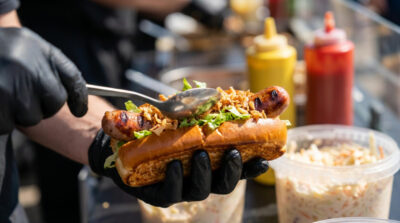
Street food kitchens – challenges your equipment needs to handle
Street food kitchens operate under very different conditions than traditional restaurants. Everything happens faster, in a much smaller space and often with a rotating team.
Limited space
A food truck or small venue requires maximum use of every inch. Equipment needs to be compact, but still powerful and ideally multifunctional.
High order turnover
During peak hours, every second counts. Equipment must heat up quickly and maintain stable performance without any drop in efficiency.
Consistency
Customers expect their burger or fries to taste exactly the same every time – regardless of the time of day or who’s on shift. That means precise temperature control and repeatable processes are essential.
Ease of use
Street food teams often include staff with varying levels of experience. Intuitive controls and a certain level of automation can make a real difference in both speed and quality.
Hygiene and maintenance
High-intensity use means frequent cleaning and servicing. Equipment should be designed to make this easier, not more complicated.
Read also: How to prepare your kitchen for the new season? Review, planning, optimization→
Frying – the backbone of street food menus
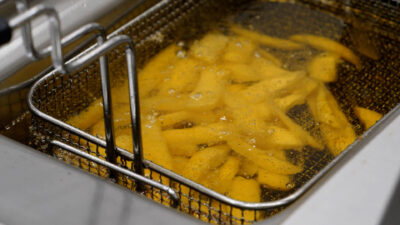
If there’s one thing that defines most street food concepts, it’s frying. Fries, nuggets, wings, onion rings – these are the items that drive a large part of daily sales.
That’s why a fryer is not just another piece of equipment. It’s the operational core of the business.
Gas vs electric fryers – what really matters?
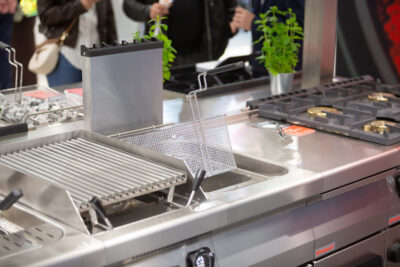
The choice between gas and electric depends on your setup and business model, but the key factors remain the same.
Fast heat-up and readiness
In professional equipment, reaching working temperature (around 190°C) takes just a few minutes. This allows you to respond quickly when demand suddenly increases.
Precise temperature control
Electronic controls help maintain stable cooking conditions, which directly impacts product quality and reduces waste.
Built-in process control features
Timers, temperature alerts and automatic shut-off functions reduce the workload for staff and help minimise errors during busy service.
Ergonomics and safety
Oil drainage valves, basket resting positions and well-designed tank construction make everyday work easier and safer, especially during cleaning.
Durability and hygiene
Stainless steel construction is the standard in professional kitchens. It ensures long-term durability and makes it easier to maintain high hygiene standards.
In practice, it all comes down to one thing: a well-chosen fryer doesn’t just speed up service – it directly improves profitability by helping you control time, energy use and oil consumption.
Maintaining quality during peak hours – the role of fry holding stations
Frying is only the first step. During busy periods, the real challenge is maintaining product quality between preparation and serving.
This is where an often underestimated piece of equipment comes into play – the fry holding station.
In practice, it allows you to:
- keep fries at the right temperature while maintaining their crispiness
- stabilise workflow during peak service
- avoid frying every portion at the last second
This becomes especially important during rush hours, when the difference between smooth service and operational chaos can come down to just a few minutes.
A well-designed setup – combining a fryer and a holding station – allows you to separate production from serving. And that’s one of the key steps in building a more professional, efficient street food operation.
Versatility in a small space – equipment that does more
In street food, every piece of equipment needs to justify its place. In simple terms, the more functions one device can handle, the better you can optimise both your space and your budget.
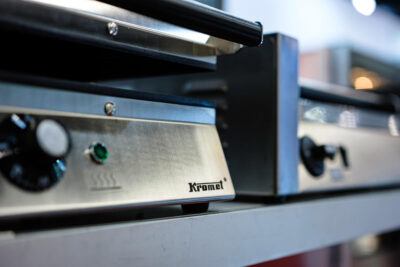
Direct frying plate – the core of the kitchen
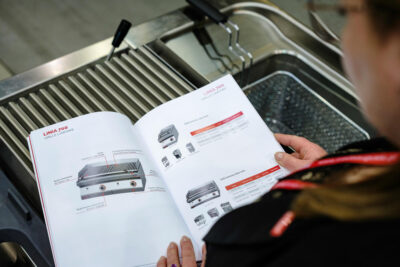
The direct frying plate is one of the most versatile pieces of equipment in any food service setup. It works just as well in classic street food concepts like burgers as it does in more diverse menus.
On a single surface, you can prepare:
- meat – burgers, steaks, chicken
- vegetables
- tortillas, wraps and breakfast items
What really matters here is even heat distribution and the ability to work continuously without losing performance during peak hours.
Salamander with lift – fast finishing and precision
A salamander is all about control over the final result.
It’s used for:
- melting cheese
- gratinating dishes
- adding a crispy finish
With an adjustable lift, you can precisely control the intensity of heat without risking overcooking or burning the product. This level of control is essential when consistency matters.
Read also: A kitchen that makes money. How ergonomics affects restaurant profitability →
Does a food truck really need a convection steam oven?
At first glance, a convection steam oven might seem like something reserved for full-scale restaurants. In reality, it’s becoming more and more common in street food concepts as well.
Why?
Because one compact oven can replace several separate pieces of equipment.
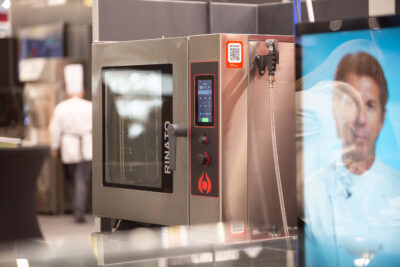
RINATO – advanced technology in a compact format
The 6-tray version is a solution that fits perfectly into the limited space of a food truck or a small venue.
Key features include:
Fast heat-up (TurboHeat)
Shortens preparation time and allows you to respond quickly to changing demand.
Precise control (DeltaPro)
Accurate temperature management, including Delta T mode, ensures consistent results.
Intuitive operation
The touchscreen interface reduces training time and helps minimise mistakes.
Lower operating costs
Cleaning systems (EasyClean / EcoWash+) reduce both chemical use and cleaning time.
Versatility
Baking, regenerating, steaming, grilling – one unit, multiple applications.
How can you use it in a street food setup?
- preparing larger batches in advance (meat, vegetables)
- regenerating semi-finished products during service
- expanding your menu without adding more equipment
In practice, this means greater flexibility and the ability to scale your business without expanding your kitchen space.
How to choose the right equipment for your concept? 3 setup examples
There’s no one-size-fits-all solution. The right equipment should always be based on your menu and service model.
Setup 1: Classic food truck (burgers + fries)
- fryer – the core of production
- fry holding station
- Direct frying plate
- optional salamander – for finishing burgers
Goal: fast turnover and consistent results.
Setup 2: Hot dog / quick street food concept
- roller grill for sausages
- rotating bun toaster
- compact fryer (optional)
Goal: maximum automation and minimal staff involvement.
Setup 3: Premium street food
- fryer
- Direct frying plate
- salamander
- convection steam oven (e.g. RINATO 6-tray model)
Goal: a broader menu, higher margins and greater control over quality.
Common mistakes investors make
When launching or upgrading a concept, it’s easy to make decisions that later limit business growth.
Choosing the cheapest equipment
Lower upfront cost often means higher expenses in the long run – from energy consumption to maintenance and servicing.
Not preparing for peak hours
Equipment may perform well during slow periods, but struggles when demand increases – and that’s exactly when you make the most money.
Ignoring kitchen ergonomics
A poorly planned layout slows down service and creates unnecessary chaos during busy shifts.
No plan for menu development
Equipment chosen only for current needs can quickly become a limitation as the concept evolves.
Read also: INTERNORGA and EUROGASTRO 2026 – trends, conversations and solutions for modern kitchens →
Equipment that works with you
Street food is all about speed, consistency and quality – and all three need to work together.
The right equipment:
- reduces preparation time
- improves team efficiency
- stabilises product quality
- allows you to expand your menu without operational chaos
That’s why investing in equipment is not just a cost – it’s the foundation of your business.
If you’re planning to launch a new concept or upgrade your current setup, it’s worth taking a strategic approach – starting with what matters most in street food: a well-designed, efficient technical setup.